Reverse-Grip Bench Press

I started experimenting with the reverse-grip bench press back when I was in my mid-20’s.  I wanted to add some variety to my chest/triceps training and remembered seeing pictures of the legendary powerlifter Anthony Clark, who was the first to do over 700 lb with this grip.
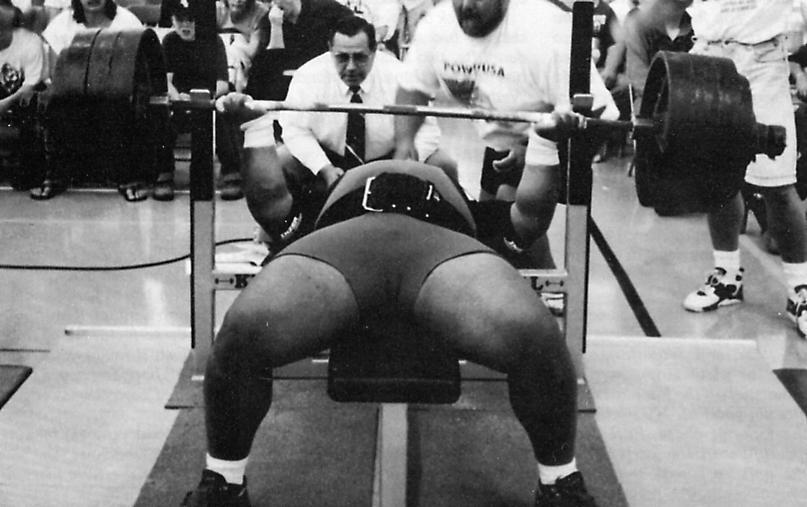
Anthony Clark
Anthony Clark

I tried the reverse grip and really enjoyed it.  I felt something different in the way it was hitting both my chest and my triceps.  And I was also pretty good at this lift–I could do almost as much weight as with the standard grip (I presume one’s individual body mechanics affect how strong he is with this lift).

It’s not something you see everyone doing.  I still remember getting stares at one of the gyms where I trained (in the Philippines) when performing this exercise.  I wish I had thought to tell them that the world record holder in the lift is Filipino (Clark passed away in 2005, but his record still stands I believe).

Turns out there may be some research to indicate this exercise does indeed activate the pectoral muscles in a slightly different way.  I keep reading about a study conducted by the Canadian Memorial Chiropractic College (Toronto) that found the reverse-grip bench press increased the activity of the upper chest (upper pectoralis) by 30% compared to the standard grip.  I can’t find any original sources, but it’s been quoted on quite a few websites.

There is, of course, one big drawback to this way of doing the bench press: safety.  Dropping the bar would probably mean it landing on your face/neck, and I’m not sure even the most attentive spotter could react in time.

Speaking of spotters, you pretty much have to have one when doing this exercise.  Getting the weights into position by yourself is virtually impossible.

There is a work-around for those who want to try reverse-grip bench press in the safest way possible: a power rack.  I’ve seen some suggest using a Smith machine as well, but I prefer the rack.  Below is a video I did to demonstrate.

As I explain in the video, it isn’t a big deal if the rack is set a couple of inches above your rib cage.  The “sticking point” is usually going to be higher than on standard grip.  This you’ll still get plenty of training stimulation even if aren’t doing the complete range of motion you’d get without the rack.
Hampton Strength Systems Review (Powerbuilding)

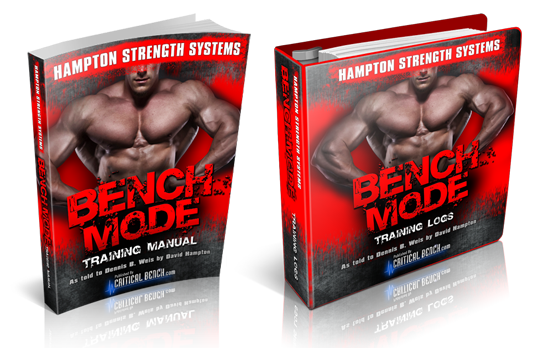
The folks at Critical Bench have a new program out called Hampton Strength Systems.  I’ve had the chance to look over it, so I’ll start my review with a summary of what you get with this program:

Hampton Strength Systems Components:

Bench Mode Training Manual: 

This book is a complete guide on how to increase your bench.  You’ll go four through training cycles, complete with assistance exercises.  The workouts are very detailed, explaining exactly what % of your one-rep max you’ll need to use for each session.

Bench Mode Printable Training Log:

You can print these sheets to record your progress in the gym.

Book of Methods:

This is an overall guide to methods for getting stronger.  These are workouts (and techniques) designed to build strength/size with specific body parts.  I really like the leg workout I saw–it looks like an efficient, simple way to build your leg strength.

Feats of Strength Training:

This manual really fascinated me.  Hampton explains how he trains for specific feats of strength, like breaking blocks with his fists.

Progressive Rep Training:

This system is based on the concept of using low reps and adding reps within your training cycle.  You’d start out with something like 3×3 on your main exercise/set and try for 3×4 on your next workout.  I know of some elite lifters who use this method.

Basic Barbell Exercises Routine:

This is a routine made up of compound exercises for the purpose of “building over all body strength and conditioning.”  The routine can be done 2-3 times a week.

Review:

Hampton Strength Systems is based on the concept of powerbuilding–gaining both size and strength.  I like this way of training because it is what most of us are after.  It’s kind of the best of both worlds, combining aspects of bodybuilding and powerlifting.

In addition to the training information, I think most readers will appreciate some of the personal stories the author includes.  I especially liked his descriptions of his personal transformation, competition experiences, etc.

I believe this program is a worthwhile investment for intermediate/advanced trainees who want to build strength and mass.

Just CLICK HERE if you are interested in checking it out–you can get a free gift (Bench Mode) that may help you decide.