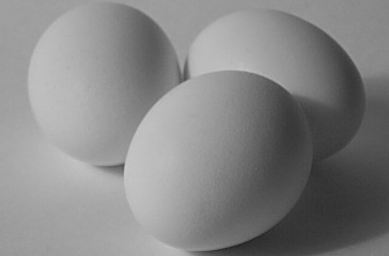
Cholesterol in Eggs

Good for Cholesterol Levels?

A while back I wrote about lowering my cholesterol without statins.  One thing I wasn’t sure about was my habit of eating eggs almost every day.  My first meal (usually around noon or so) usually consists only of one or two eggs–all protein/fat and no carbohydrates.  This is part of the Renegade Diet strategy for optimizing fat burning hormones and energy levels throughout the day.

Here’s the concern I had: a large egg has around 185 milligrams of cholesterol or more, which is about 2/3 the recommended daily intake of cholesterol.  Whole eggs were once considered unhealthy because of this, but there’s also a significant number of studies showing no real connection between egg consumption and heart disease.

The consumption of whole eggs is controversial to say the least.  Researchers from the Canadian Journal of Cardiology (2010) have expressed concerns that the public has been lulled into a false sense of safety regarding dietary cholesterol: “The evidence presented in the current review suggests that the widespread perception among the public and health care professionals that dietary cholesterol is benign is misplaced, and that improved education is needed to correct this misconception.”1

But a recent study suggests consuming whole eggs can be beneficial when other aspects of one’s diet are in order.  Researchers took participants with metabolic syndrome and asked them to follow a moderately carbohydrate restricted diet (25-20% of calories coming from carbs).  Half of them consumed three whole eggs a day while the other half consumed the equivalent in yolk-free egg substitutes.  Both groups experienced improvements in blood lipid profiles (triglycerides and cholesterol levels).  But those who ate whole eggs had greater improvement in both the increase of HDL levels (the “good” cholesterol) and the decrease of VLDL levels (the most dangerous type of “bad” cholesterol).   The group that consumed whole eggs also experienced improvements in insulin levels.

Here’s something else I find fascinating in this study: I mentioned the importance of particle size when I first wrote about cholesterol  (bigger, “fluffier” particles are safer than smaller ones).  The subjects who ate eggs daily also experienced an increase in particle size in both their HDL and LDL cholesterol.2

It seems consuming whole eggs is beneficial if it is part of a dietary strategy that restricts carbohydrates.

References:

1. Can J Cardiol. 2010 Nov;26(9):e336-9. Dietary cholesterol and egg yolks: not for patients at risk of vascular disease.

2. Metabolism. 2013 Mar;62(3):400-10. doi: 10.1016/j.metabol.2012.08.014. Epub 2012 Sep 27. Whole egg consumption improves lipoprotein profiles and insulin sensitivity to a greater extent than yolk-free egg substitute in individuals with metabolic syndrome.
Body Fat for Men: Testosterone, Strength and Vitality

BodyFat

What is the ideal body fat level for men?

One of my main interest in researching/writing this article is to look at the connection between leanness and healthy hormone levels.  With that in mind, I’ll start with a quote from Jason Ferruggia’s Renegade Diet:

“Someone at 20% bodyfat is almost guaranteed to have high estrogen as well as a host of other problems that would be virtually non existent at 10% bodyfat.”

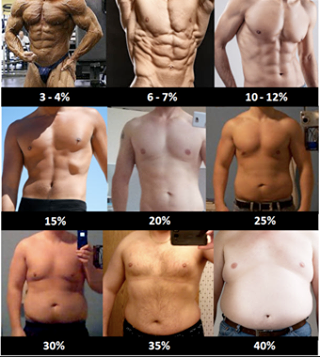
High body fat levels are  correlated with low testosterone and high estrogen in men (losing combination).  One recent study, in fact, looked at over 800 men, measuring both their body fat and testosterone levels.  As expected, higher body fat percentages were associated with lower testosterone levels.  But the scope and length of this study lead researchers to this conclusion: “Longitudinal analyses showing no influence of baseline hormone levels on change in anthropometric measures imply that body composition affects hormone levels and not the reverse.”1

This study just reinforced something we already know: getting lean and staying that way is important for overall health and vitality.

Is it possible to get too lean as far as hormones go?  Maybe.  One study tracked a natural (drug-free) bodybuilder for six months as he prepared for a competition.  He dieted/exercised his way from 14.8% to 4.5% body fat.  By the time he stepped on stage his testosterone levels had gone from 9.22 ng/mL to 2.27 ng/mL–that’s an 80% reduction.  He also reported a drastic increase in “mood disturbance” leading up to the competition, and his strength level had not fully recovered six months afterwards.2

We have to be careful about jumping to too many conclusions with this study, especially since is based on just one subject/person.   But I’m guessing we’d see similar results if other natural bodybuilders were studied like he was–especially with guys who cut significant weight/fat.  Regardless, there are a couple of very important lessons/reminders:

1. The “shredded” look you see in pictures of bodybuilders and fitness models isn’t their year-round look (especially in the case of natural trainees).

2. The dieting required to go under 5% body fat is likely to make you moody and weaker.  Doesn’t sound like something I’d want to do unless there was a substantial financial reward (along with a pizza and doughnuts) waiting for me at the end of the process.

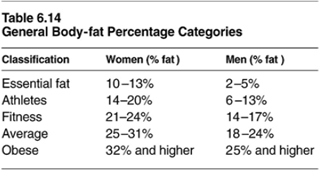
bodyfattableIt seems there is a happy medium–a range in body fat that would optimize testosterone levels and health for most men.  It’s probably somewhere between 6-17%.   This would put you in the category of “athlete” or “fitness” for most charts I’ve seen online.

Most of us will look great if we keep ourselves somewhere in this range (trainees will usually have visible abs somewhere between 7-10% depending on genetics), and there’s always the option of moving towards the leaner end of this spectrum for certain events or seasons (going to the beach, a pictorial, etc.).

This optimal body fat % range is what interests me–I want to feel good, look good, and stay in good condition year-round.

References:

1. J Clin Endocrinol Metab. 2013 Apr 26. Sex Steroid Hormone Levels and Body Composition in Men.

2.Int J Sports Physiol Perform. 2013 Feb 14. Natural Bodybuilding Competition Preparation and Recovery: A 12-Month Case Study.