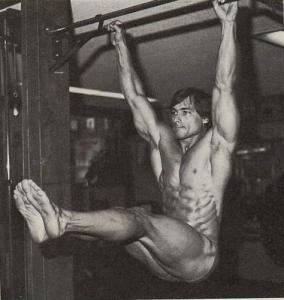
I remember doing concentration curls back in the early days of my training. I was in the high school gym and an older teammate on the football team gave me a tip. He advised me to slowly lower the weight over a count of a few seconds. This was my first time to hear about “negatives.”
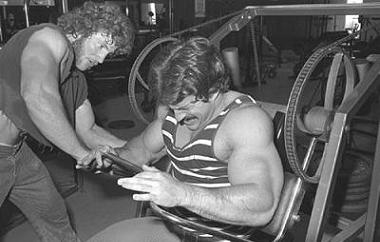
I’ve learned more about this kind of training over the years. Mike Mentzer believed in emphasizing the eccentric/negative part of the repetition. He advocated doing a few slow negative reps at the end of an all-out intense set.
One advantage of this method is maximizing time under tension–the amount of time the muscle is under the stimulus of a given weight.
Overloading the negative repetition is another variation of this technique. Here’s the idea: you can resist more weight than you can actually lift. Let’s say you can bench press 275 lb. Chances are you could slowly lower more than that–probably well over 300 lb. By doing so you would be putting 300+ lb of tension on your muscles, even if you can’t lift that amount of weight.
At least one study suggests this way of training is effective. Forty male subjects were divided into five groups and trained using the leg press for 3x a week. They all used the same percentage of their one-rep max during the concentric (lifting) part of the repetitions. But each group used a different % of their one-rep max for the eccentric (negative part of the lift): 0, 33, 66, 100, or 138%. Strength gains were the same in those using the 100% and 138% load for their eccentric training. But only the trainees who overloaded the negative repetitions (the 138% group) gained mass in their legs (they were also the only trainees to increase bone mineral density).1
One if the biggest challenges with this kind of training is the need for a spotter on certain lifts. But there is a pretty simple solution that can be applied to many exercises: lifting the weight with two arms/legs, then lowering it with one. This works very well on the leg press, for example.
We shouldn’t go crazy over one study or think of this technique as a “magic bullet.” But it seems like it is worth a try if you are trying to break plateaus in your size gains.
Reference:
1.Eur J Appl Physiol. 2014 Jul 22. Early-phase musculoskeletal adaptations to different levels of eccentric resistance after 8 weeks of lower body training.