Muscle Memory

The only serious weightlifting injury I’ve ever had happened back in 1996.  I had been experimenting with heavy weighted dips (doing this exercise with over 100 lb. attached to a belt).  It was great for my ego, but I think it is largely to blame for wearing out all the cartilage in my AC joint (where your clavicle meets the shoulder).  My doctors told me it was a pretty common injury among those who lift weights.  My only option (other than live in pain) was to surgically remove the bone spur that had developed.

This meant I’d have to lay off the weight training for six weeks or so.  I still remember returning to the gym for the first time after the layoff.  I was wearing one of my favorite sleeveless workout shirts.  Looking in the mirror was depressing–my arms looked like pipe cleaners to me.  Needless to say, I probably didn’t look nearly as bad as I thought.  Regardless, my arms had clearly lost some of their size.

Fortunately my size and strength returned very quickly. I actually broke some personal strength records within the next year or two.

I’m using this little story to illustrate a concept that is a bodybuilder or strength athlete’s best friend: muscle memory.

Technically this term (as most commonly used) has little to do with strength and size.  Muscle memory refers to things your body “remembers” to do after multiple repetitions.  My fingers, for example, are effortlessly typing this article without my brain thinking about each individual keystroke.

But many in the iron game have used this term to refer to what I experienced after my injury:  gains in strength and size usually come back much more quickly than it originally took to earn them.  We’ve kind of adopted “muscle memory” as a term to explain this phenomenon.
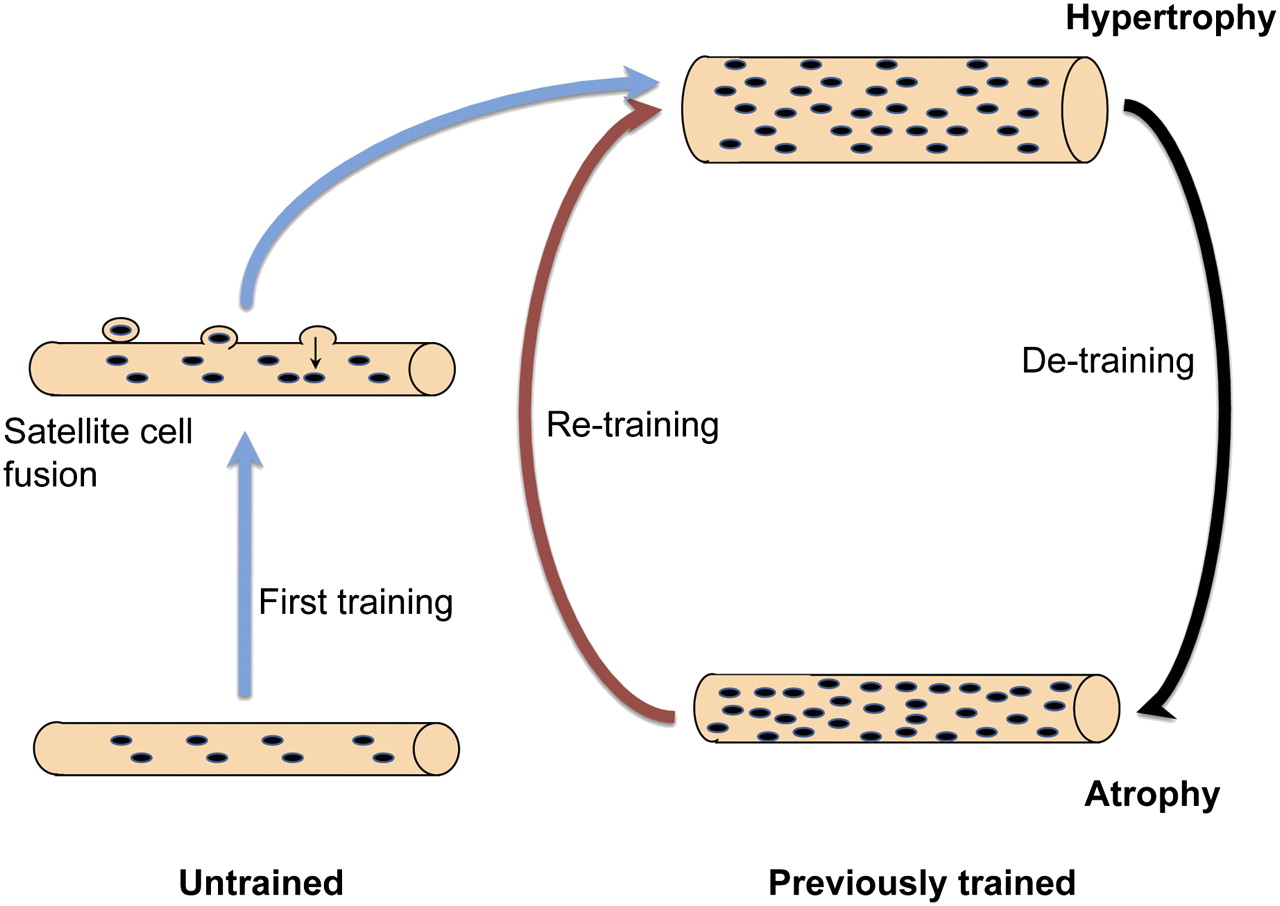
satellitecellsI have since learned how this works.  It has to do with satellite cells and their role in hypertrophy (muscle growth).  Satellite cells are located on the outside of muscle fibers and normally lay dormant.  But when a muscle is stressed/damaged through resistance training, they go to work.  These cells multiply and go to the site of the damage (keep in mind we are talking about damage at the microscopic level).

Here’s where it gets really interesting: satellite cells “donate” their nuclei to the muscle cells, which its one of the factors that cause it to increase in size.  Trained muscle cells have more nuclei than untrained muscles, and this change remains even after one stops training.  The change, in fact, may be permanent.1

Formerly trained muscles, therefore, are already primed to grow back to their previous levels of size and strength–the additional nuclei are already there in the muscle cells, “waiting” to do their thing.

Muscle memory is real.  This is good to know if you need to take some time of due to injury, illness, or any other reason.

Reference:
1. J Exp Biol. 2016 Jan;219(Pt 2):235-42. doi: 10.1242/jeb.124495. Muscle memory and a new cellular model for muscle atrophy and hypertrophy.
High Rep Training

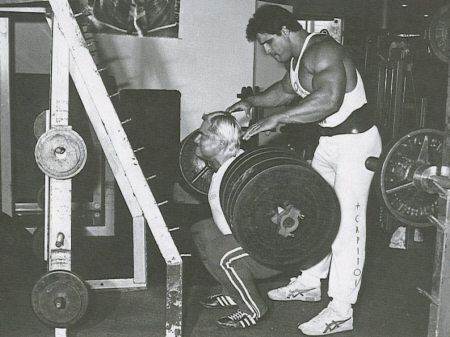
I’ll start this post off with a video I first saw years ago.  Here is the legendary Tom Platz doing high repetition squats with heavy weight (well over 500 lb).  This video was filmed back in 1993.  Tom Platz and Dr. Fred Hatfield (aka “Dr Squat) were doing a “squat off” in Germany.  Hatfield won the one-rep max competition by squatting 855 lb.  Platz won the rep competition with the weight you see here:

A while back I wrote an article on the best rep range for building muscle and burning fat.  I basically argued that a 5-10 rep range is going to be ideal for both of these goals.  I still believe that–most of your gains will probably come from this range.

But more advanced and older trainees may want to consider experimenting with higher repetitions (let’s say 15 and up).  There are some good reason to do so:

Leg Traininghighreptrainingplatz2

I’ve heard several bodybuilders say they had better leg growth from training with higher repetitions.  This makes sense because the quadriceps in particular tend to have a high number of both fast-twitch and slow-twitch fibers.  You’ve just seen what Platz was capable of in his prime–his legendary thighs were built with both heavy lifting and high reps.

Joint Health

High rep training has the advantage of being able to stimulate the muscles with less strain on the joints.  Older trainees in particular may find this to be very helpful.  But even younger guys can benefit from simply giving the joints a break.

Lactic Acid

Training with higher reps will produce more lactic acid, which in turn tends to produce growth hormone (a helpful hormone for burning fat).

Mental Toughness

I’ve found that training beyond my usual rep range also helps me learn to push beyond the pain barrier and force my body to keep going when my muscles are screaming to stop.

Variety in Training

Going to the gym can get kind of boring if you do the same thing week after week.  Dropping the weight and going for higher repetitions is a simple way to challenge yourself and keep things interesting.

Research

Some recent studies indicate that training with high repetitions is an effective way to build muscle.  One study, for example, took fifteen healthy young men and randomly assigned them to different workouts, measuring their bodies’ responses to different training stimuli: 1.  One set to failure with 80% of one-rep max (1RM)  2.  Three sets to failure with 80% of 1RM, and 3.  Three sets to failure with 30% of 1RM.  Needless to say the third workout tended to be much higher in repetitions (20-23).   They found that lower weights/high reps produced a similar anabolic response to lifting with heavier weight and low reps.1 This is just one of many studies you can find verifying the efficacy of this kind of training.   Bottom line: training heavy is not the only way to build muscle.

These are just reasons to consider incorporating higher reps into your workout.  Now let me give you some practical tips (in no particular order of importance):

Exercise Selection:  I think you’ll find some exercises simply aren’t good choices for high reps.  I love deadlifting, but I rarely go over 5 repetitions for that particular exercise.  My form simply starts to break down if I try to go beyond that.  The same goes for front squats.

I tend to be old-school and prefer free weight exercises, but it may be advantageous to consider machines with this kind of training–especially if you are working out without a spotter.

Time Under Tension:  Using less weight will mean you can lift more slowly and deliberately.  Take advantage of this and maximize the time your muscles are under the tension of the weight.

“Burnout” Set:  One of my favorite techniques is to finish my training with one or two sets of high reps after I’ve done some heavier sets.

I hope you find these tips helpful.  Try them and see if they don’t produce new gains.  Please check out my list of recommended workout programs if you’d like more detailed training guides.

1. J Appl Physiol (1985). 2012 Jul;113(1):71-7. doi: 10.1152/japplphysiol.00307.2012. Epub 2012 Apr 19. Resistance exercise load does not determine training-mediated hypertrophic gains in young men.