I’ve made a lot of mistakes during my lifting career, most of which were committed in my 20’s. The biggest (and most expensive) blunder was to spend a lot of money on supplements (now I just stick to a handful of vitamins/supplements).
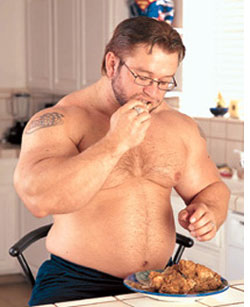
Here’s something else I would do differently if I could rewind and do it all over again: I would have abandoned “bulking” as a strategy for building muscle after my early 20’s (if not earlier). By “bulking” I mean eating tons of food/calories with little regard for the kind of weight gained (fat vs. muscle).
Before I go any further let me say that I think bulking may be useful in a few circumstances. Here are some examples:
*Guys in their teens (or maybe late 20’s) who are naturally thin and looking to put on their first 20-30 lb. of muscle (I’d recommend NNMB 2.0 for this category).
*Skinny guys (ectomorphs) who have a really hard time putting on weight.
*Powerlifters who are only concerned about getting stronger and having favorable leverages for strength (with little/no regard for aesthetics).
But I did most of my “bulking” when none of these scenarios applied to me. I remember being in my late 20’s and following a program that called for drinking one gallon of whole milk a day (around 2,400 calories, not counting the other food I was eating). This would have been fine if I was a skinny teenager, but I wasn’t. And I already had over a decade of training under my belt.
I didn’t have much to show for these “bulking cycles” except for fat gain. This, of course, meant I had to diet and get rid of the excess “insulation.” I would have opted for slow but steady strength/muscle gains if I had it all to do over.
Anyway, here are some things I’d urge you to consider before getting caught up in a vicious cycle of getting too fat and having to diet it off:
*There are limits to how much muscle you can put on naturally. Don’t believe you can eat enough calories/protein (or take enough supplements) to look like a guy who is using steroids.
*Remember that you’ll look much more muscular (and attractive to the ladies) if you keep a reasonably low body fat level.
*Overeating is associated with inflammation. In addition to being bad for your overall health, a constant state of inflammation may actually hinder your muscle growth.1
I’ll leave you with this final quote:
“Beyond your first two years of training gains will usually come at a snails pace. A gain of one pound of real, solid muscle tissue without any fat gain, per month, would be outstanding progress for someone who has been training properly for more than three years.” -Jason Ferruggia, The Renegade Diet
Notes:
1. Brad Pilon (author of Eat Stop Eat) has created a website on the Inflamation Theory of Muscle Growth. The presentation is a bit technical (and long), so let me summarize it this way: weight training causes an acute, beneficial inflammation response. But chronic, general inflammation (caused by overeating, etc.) could interfere with the body’s ability to recognize and respond to a weight training session.